


How to Choose a Wedding Hairstylist for Your Day
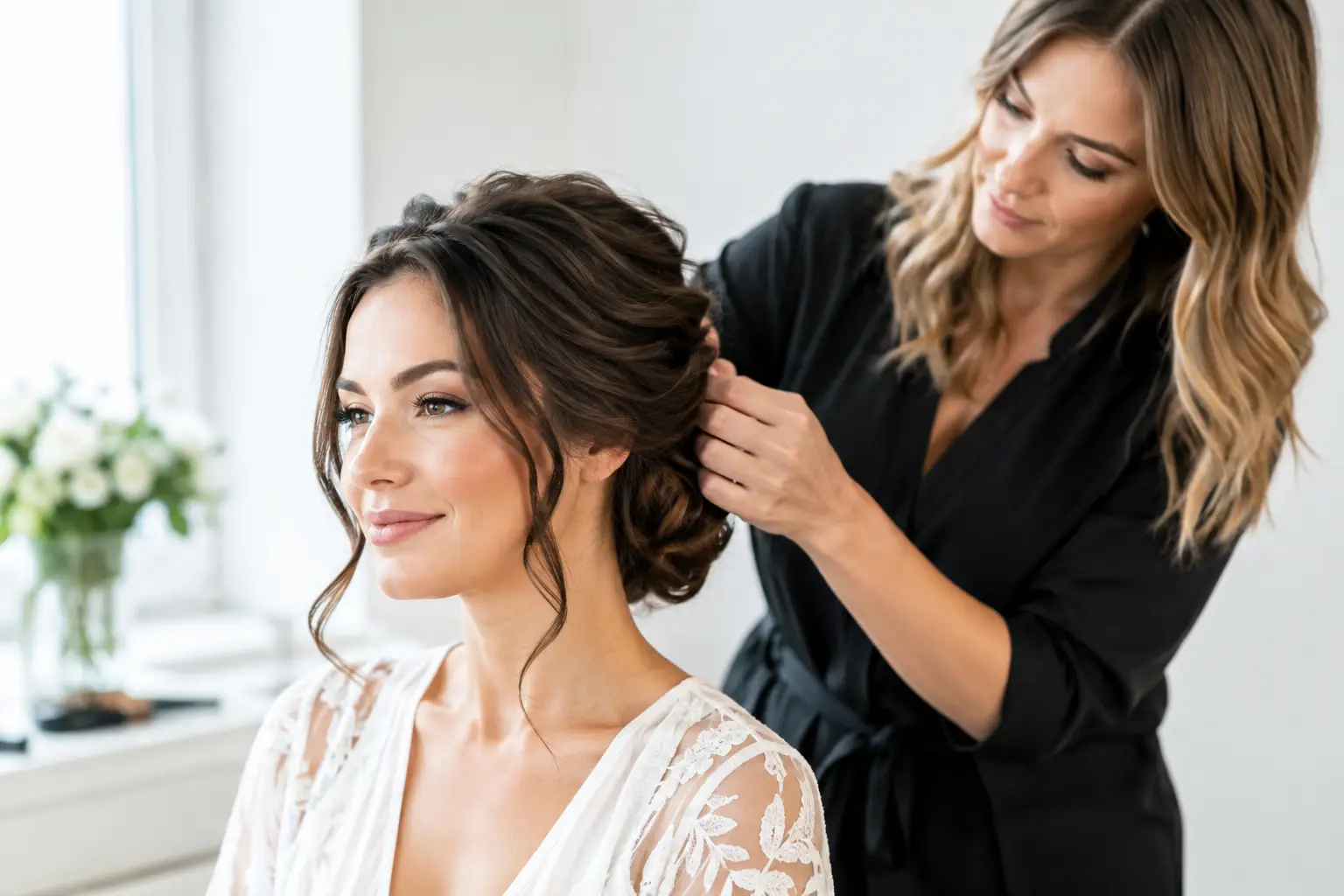
Your wedding hair will be seen from every angle: in the quiet moment before the ceremony, beneath changing light during portraits, across a crowded dance floor, and in photographs you will return to for decades. That is why knowing how to choose a wedding hairstylist is less about finding a pretty updo on social media and more about selecting an artist with the technical range, aesthetic judgment, and composure to create a look that feels entirely like you.
For a luxury celebration, hair is not an afterthought to the gown. It is part of the complete visual language – one that must complement the silhouette of your dress, the scale of your accessories, your personal style, and the setting itself. The right artist makes all of those elements feel considered without making the result appear overworked.
Start With the Kind of Finish You Want
Before comparing artists, define the feeling you want your bridal look to carry. You do not need to arrive with a precise hairstyle name. In fact, a collection of images that reflects your preferences is often more useful than one rigid reference photo.
Consider whether you are drawn to polished Hollywood waves, a sculptural chignon, softly textured volume, a sleek low knot, romantic braiding, or hair worn down with a controlled, luminous finish. Look beyond the hairstyle itself. Notice the balance of shine and texture, whether the hair feels structured or effortless, and how it works with the model’s neckline, jewelry, veil, or dupatta.
A skilled hairstylist will translate the mood of an inspiration image for your own hair density, texture, length, and face shape. A reference is a direction, not a promise of identical results. The most elegant bridal hair preserves the spirit of the image while looking natural on the person wearing it.
How to Choose a Wedding Hairstylist From Their Portfolio
A strong portfolio should show more than beautiful close-ups. Look for consistency across real weddings, varied lighting, multiple angles, and different hair types. Editorial images can reveal an artist’s eye for shape and finish, while wedding imagery demonstrates how that work wears through a full celebration.
Pay close attention to the details that separate a polished image from a durable hairstyle. Are the hairlines soft but intentional? Do waves have a refined pattern rather than loose, undefined movement? Are updos balanced from the side and back, not only from the front? Does the hair still look touchable, even when it has the hold required for a long day?
It also helps to look for work that resembles your desired level of formality. An artist who excels at undone, beach-inspired texture may not be the ideal choice for a formal evening at a New York ballroom. Equally, a hairstylist known for immaculate, high-gloss styling may not be the best fit for a relaxed outdoor ceremony where movement and ease are central to the aesthetic. Neither approach is better. The question is whether the artist’s point of view aligns with yours.
Look for Experience Across Hair Textures and Traditions
For multicultural celebrations, technical versatility is essential. A hairstylist should understand how to prepare, style, and secure a range of textures without treating any hair type as an exception. This matters particularly when a wedding party includes different densities, curl patterns, protective styles, extensions, or culturally significant adornments.
South Asian bridal hair, for example, requires an understanding of both beauty and engineering. A style may need to support a maang tikka, passa, dupatta, floral elements, or substantial jewelry while remaining comfortable and balanced through multiple events. The artistry lies in making that structure feel graceful rather than rigid.
Ask to see relevant examples, but do not limit the conversation to images alone. A thoughtful artist can explain how they would prepare your hair, accommodate adornments, and evolve the look between ceremony, reception, and any wardrobe changes. Cultural fluency should feel informed and respectful, never performative.
Treat the Trial as a Creative Appointment
A trial is where you learn whether an artist can hear your vision and elevate it. It is not simply a rehearsal for one hairstyle. Come prepared with your inspiration images, photographs of your gown if available, details about your veil or jewelry, and an honest description of how you normally wear your hair.
Be open about what you do not want as well. If you dislike a tight crown, visible pins, excessive teasing, or curls that feel too pageant-like, say so. Specific feedback gives the artist a clearer framework. The best collaboration is candid, not overly polite.
During the appointment, notice how the hairstylist works. Do they assess your hair’s natural behavior before beginning? Do they explain why a modification may improve longevity or balance? Are they receptive when you ask for more softness, height, or restraint? Technical confidence is valuable, but so is the ability to edit.
Photograph the finished trial in natural light and with flash if possible. Bridal hair has to read beautifully in person and on camera, and those are not always the same thing. What feels subtle in a mirror may disappear in photographs, while a style that seems highly polished up close can become beautifully dimensional in imagery.
Ask About Timing, Team Size, and the Wedding-Day Plan
Luxury service is often felt in the details that guests never see. A hairstylist should be able to discuss timing with precision: when they will arrive, how long each service will take, where the bride falls in the schedule, and how the team will accommodate a larger wedding party.
For an intimate group, one artist may be ideal. For a bridal party with several attendants, mothers, or multiple events, a coordinated team may be necessary. The goal is not simply to finish everyone quickly. It is to preserve a calm, unhurried atmosphere while allowing time for dressing, portraits, touch-ups, and inevitable last-minute adjustments.
Ask whether the artist stays through veil placement and final dressing, and whether touch-up services are available for portraits or a reception transformation. If you are planning a destination wedding, clarify travel dates, early-call logistics, accommodations, kit requirements, and contingencies for weather. Humidity in Florida, wind at a coastal venue, and a long city-to-country transfer all influence the products, prep, and styling strategy.
Understand What You Are Booking
Premium bridal hair is a custom service, not a menu selection. The estimate should make clear what is included: the trial, wedding-day styling, additional services, travel, assistants, early-start fees, extensions or hair padding if needed, and touch-up coverage. A transparent agreement protects both the client and the artist.
Price alone is rarely a useful measure of fit. An experienced artist’s rate reflects more than the finished hour in the chair. It includes professional education, kit quality, sanitation, scheduling discipline, visual expertise, and the ability to perform under the pressure of a live event. Still, the highest quote is not automatically the right choice. Invest in the artist whose work, communication, and process make you feel understood.
Choose the Artist Who Makes You Feel Seen
The final decision often comes down to rapport. Your hairstylist will be present during one of the most intimate parts of your wedding day, often before the room is fully awake and the ceremony begins. You want someone calm, attentive, and capable of protecting the atmosphere as much as the hairstyle.
At BridalGal, that standard is rooted in couture-minded finish, multicultural expertise, and hair that performs beautifully across photography, video, and celebration. Yet the principle is universal: the right artist does not impose a signature look on every bride. They recognize what makes you distinctive, then refine it with skill.
Choose the person whose work you admire, whose process you trust, and whose presence lets you sit back in the chair knowing every detail is in capable hands. That sense of ease is often the most beautiful part of the finished look.