


Indian Weddings and the Art of Bridal Beauty
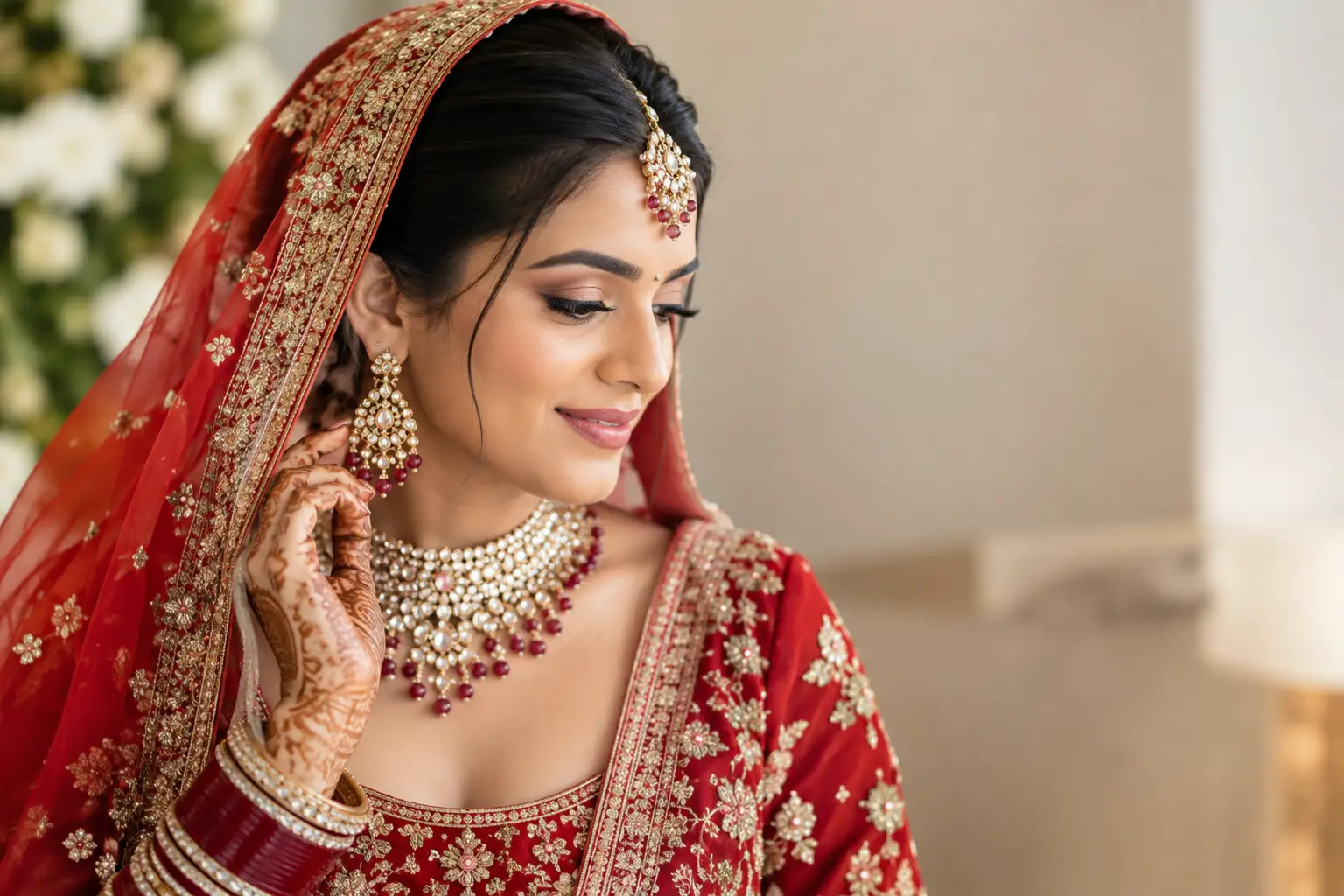
A bridal look may be photographed for a few hours, but at an Indian wedding, it is experienced across an entire world of color, ritual, movement, and family history. It must hold its own beside embroidered silks, heirloom jewelry, fragrant florals, changing light, and the close attention of everyone in the room. The work is not simply to create beautiful makeup and hair. It is to create a composed, personal image that feels at home in the celebration.
For the bride, this begins with an artist who understands that the beauty direction is inseparable from the occasion. A soft matte complexion, sculpted bun, or luminous eye can be technically impeccable, yet still feel disconnected if it ignores the meaning of the attire, the ceremony schedule, or the bride’s own relationship to tradition. The most memorable work has polish, but it also has context.
Indian Weddings Are Not One Visual Language
The phrase “Indian wedding” holds remarkable range. A Punjabi bride in a richly embellished red lehenga, a South Indian bride in a silk Kanjeevaram with temple jewelry, a Gujarati bride preparing for a garba celebration, and a Muslim bride wearing a contemporary sharara may each have completely different references, rituals, and expectations. Even within one family, regional traditions and modern preferences can meet in unexpected ways.
That is why a prescriptive approach to bridal beauty rarely serves the bride. A classic red lip may be perfect for one event and too expected for another. A sleek center-parted bun can create beautiful structure beneath a dupatta, while loose Hollywood-inspired waves may better suit a reception gown. The decision should come from the full picture: the bride’s features, her comfort with makeup, the architecture of her jewelry, the silhouette of the outfit, and the atmosphere she wants to create.
Cultural fluency does not mean reducing a bride to a checklist of expected details. It means asking more intelligent questions. Which ceremonies matter most to you? Will you change outfits? How is your dupatta being draped? Do you want a look that honors a family tradition, or are you deliberately creating something new? Those answers shape artistry far more meaningfully than a trend board alone.
A Look Designed for Ceremony and the Camera
Indian weddings are visually demanding in the best possible way. A bride may begin before dawn, move between indoor and outdoor spaces, sit beneath bright ceremonial lighting, greet hundreds of guests, dance late into the evening, and appear in still photography and motion footage throughout. Beauty must be designed for every one of those conditions.
This is where professional preparation becomes visible. Skin needs dimension rather than a flat, overly powdered finish. Foundation must be carefully matched through the face, neck, and décolletage, especially when shoulders or the back are exposed. Concealer and contour should shape the face without leaving a stark flashback in photography. Strategic setting creates longevity while allowing skin to remain alive in person.
The same balance applies to eyes. Indian bridal beauty often invites a more expressive eye, but depth should be intentional. A densely lined lash line, warm metallic lid, tailored wing, or individual lashes can photograph with extraordinary impact when the proportions suit the bride’s eye shape. The goal is definition that endures tears, heat, and hours of celebration, not heaviness for its own sake.
Hair carries equal responsibility. It has to support the visual weight of a maang tikka, passa, veil, or floral adornment without appearing rigid. A low bun may offer an elegant base for elaborate jewelry and a dupatta. A textured braid can echo the romance of a mehndi evening. For a reception, high-gloss waves or a sculptural ponytail may bring a couture finish to a modern gown. The strongest choice is the one that complements the entire look from every angle, including the angles a photographer will find without warning.
Longevity Is a Luxury Detail
Long-wear artistry should never feel like armor. The bride still needs to recognize herself at close range and feel comfortable through hugs, laughter, meals, and dancing. This requires considered layering, appropriate skincare, controlled complexion prep, and formulas selected for her skin type and the climate.
There are trade-offs. A dewy finish is breathtaking in soft window light, but may need more control in humid weather or beneath intense production lighting. A bold lip is striking for portraits, though it calls for a practical plan if the day includes frequent changes and a long ceremony. The answer is not to avoid either choice. It is to build the look with the real schedule in mind.
The Beauty Timeline Deserves Its Own Direction
A multi-event celebration benefits from a beauty plan, not a series of disconnected appointments. The mehndi, sangeet, wedding ceremony, and reception can each have a distinct identity while still reading as one woman’s story.
For a mehndi, many brides choose a fresher, more effortless expression: glowing skin, soft definition, dimensional hair, and color that works beautifully beside henna. A sangeet often allows for greater drama, whether that means a burnished eye, a statement lip, or polished waves built for movement. The wedding-day look may carry the greatest ceremonial presence, with richer eyes, impeccable skin, and secure styling for the drape and jewelry. The reception is often the moment to shift the mood completely, leaning into refined glamour, a sharper silhouette, or a fashion-forward detail.
This progression should feel deliberate rather than repetitive. Wearing a red lehenga does not require the same red lip at every event, nor does a bride have to choose maximal makeup simply because the outfit is ornate. Restraint can be exceptionally powerful against elaborate craftsmanship. Conversely, a clean, minimal gown can invite bolder beauty. Contrast is often what makes the finished image feel modern.
Trials Create Space for Better Decisions
The bridal trial is the setting for precision, not just a preview. It is where an artist can assess how the skin accepts product, refine the foundation tone, test lash weight, review hair density and extensions if needed, and see how the intended makeup reads beside the bridal color palette. Whenever possible, bringing jewelry references and photographs of the actual outfits makes the conversation more exact.
It is also the right time to be honest about personal style. A bride who never wears eyeliner may not feel like herself in an intensely graphic eye, no matter how impressive it appears in a reference image. Likewise, someone who loves fashion and editorial makeup may want a more dimensional, directional result than conventional bridal inspiration provides. Neither approach is more correct. The artistry lies in translating the bride’s point of view into a look capable of meeting the moment.
A Couture Point of View, Not a Costume
There is a meaningful difference between honoring tradition and treating it as decoration. Indian bridal beauty is at its most compelling when it respects the ceremonial elements while allowing the bride’s individuality to lead. A veil, nath, jhumkas, or layered necklace should be integrated into the beauty composition, not added as an afterthought.
This is especially relevant for multicultural weddings. A bride may wear a sari for one ceremony and a Western gown later in the evening. A couple may blend customs from different regions, faiths, or families. The beauty direction can offer continuity through a signature complexion finish, a recurring color story, or hair that evolves elegantly from one event to the next. It does not need to force every look into one aesthetic.
For destination celebrations, the setting becomes another collaborator. A New York ballroom, a Florida waterfront venue, and a sunlit palace courtyard each ask different things of complexion, hair, and timing. Humidity, wind, travel logistics, and ceremony hours are practical concerns, but they are creative considerations too. When accounted for early, they protect the bride’s experience and the final imagery.
The finest bridal beauty does not compete with an Indian wedding’s grandeur. It brings focus to it. Choose an artist who can read the details, listen closely, and create enough structure for the look to last – while leaving room for you to look radiant, present, and entirely yourself when the first photograph is taken.