


Bridal Makeup for Video That Looks Like You
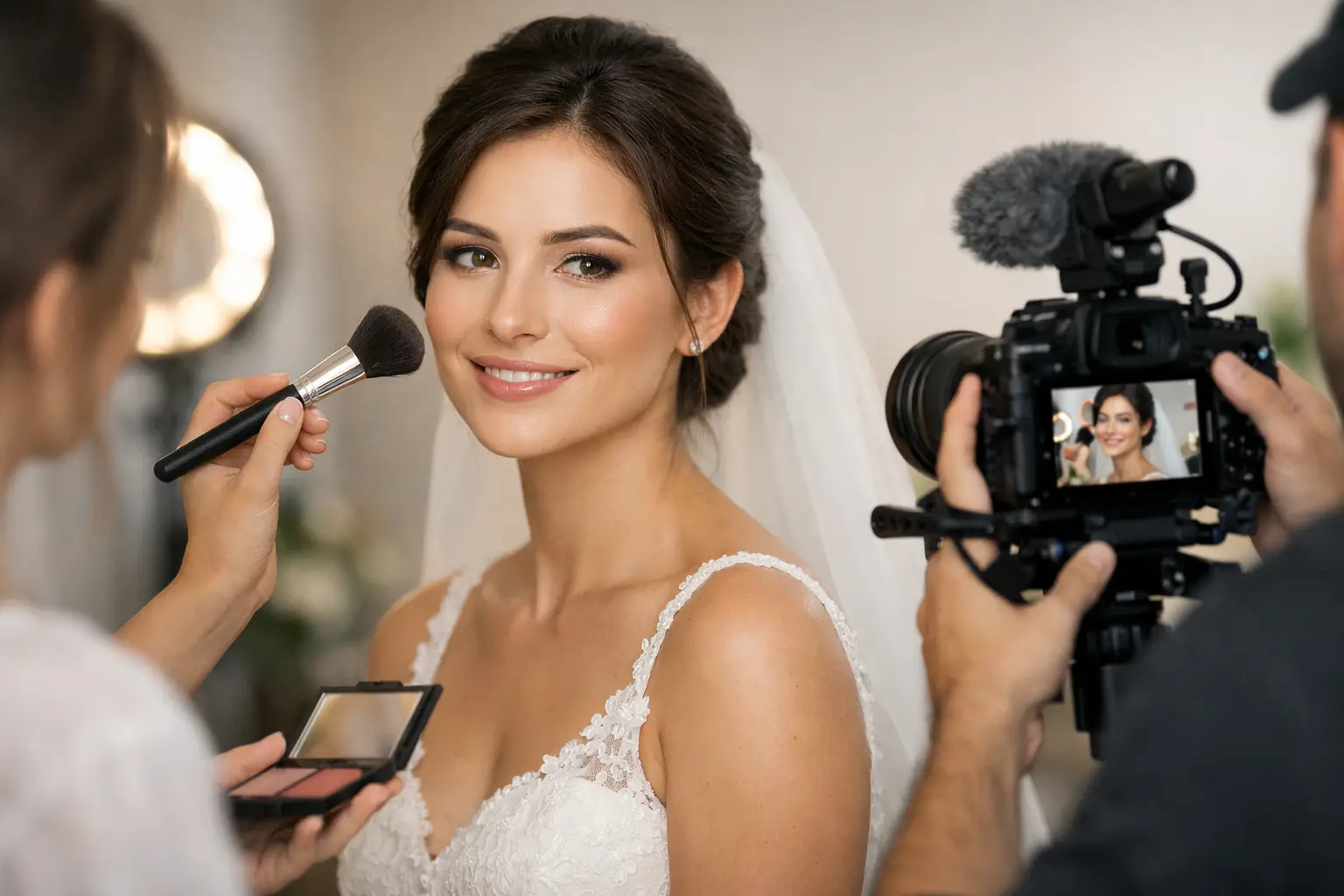
The first time you see your wedding morning on film, the details become their own kind of heirloom: a parent fastening a bracelet, the quiet before the ceremony, a veil settling into place, the expression you make when you realize the day is finally here. Bridal makeup for video should honor that intimacy. It has to look exquisite in motion, under changing light, at close range, and beside the people you love, while still feeling unmistakably like you.
A camera does not simply record makeup. It interprets texture, contrast, undertone, and reflection. The finish that looks luminous in a bridal suite may read as shine in direct sun; a carefully sculpted eye can become nearly invisible under soft, diffused light. This is why on-camera bridal beauty is not about applying more makeup. It is about making more considered choices.
Bridal Makeup for Video Begins With Light
Video is alive in a way a still image is not. Your makeup will be seen as you turn toward a window, step from a car, embrace guests outdoors, and dance beneath reception lighting. A polished look must hold its character through each transition.
Natural daylight is often the most revealing. It softens some details but can expose dryness, heavy powder, mismatched complexion products, and overly warm bronzer. Indoor film lighting can flatten dimension, while evening spaces may require a touch more definition around the eyes and face. The goal is not to predict every lighting condition perfectly. It is to create balanced skin and thoughtful structure that remain elegant in all of them.
For this reason, an experienced artist asks specific questions well before the wedding day. Will preparation take place near large windows? Is the ceremony outdoors? Will the reception include candlelight, uplighting, or a dramatic ballroom installation? Is there a cinematic videographer capturing close, editorial footage or a documentary team working from a distance? These details influence the artistry as much as the gown, floral palette, or venue.
Skin That Moves Beautifully on Camera
The most convincing bridal complexion has dimension. It looks like skin because it is built in fine, intentional layers rather than covered with a single opaque finish.
Preparation is where that finish begins. Hydration should be tailored to the skin, not treated as a universal ritual. A rich cream can be beautiful on dry skin, yet too emollient beneath makeup for someone who becomes luminous through the T-zone. Conversely, an aggressively matte base can emphasize texture and make the complexion look flat by the time portraits begin. The right balance often combines targeted hydration with strategic priming, then allows the foundation to be worked into the skin rather than sitting visibly on top of it.
Long-wear does not have to mean fully matte. A modern bridal base may have a satin center, softly set perimeter, and controlled radiance at the high points. This distinction matters on video. Light-catching products placed deliberately on the cheekbones and temples can give the complexion life. High-shine formulas across the forehead, nose, and chin tend to compete with the face itself.
Texture deserves the same attention as coverage. Cameras can capture flakes around the nose, product settling beneath the eyes, or powder collecting around expression lines. The answer is rarely to add another layer. Often, it is to use less product, press it in more carefully, and preserve the natural movement of the face.
Complexion matching is a visual discipline
A foundation match must work across the face, neck, chest, and shoulders, especially with strapless, off-the-shoulder, or richly colored bridal attire. This is particularly important for multicultural bridal beauty, where undertone may be complex and traditional garments can shift how complexion color is perceived.
A golden base that appears harmonious beside an ivory gown may look too warm against a deep red lehenga. Likewise, makeup intended to complement a cool white dress can need adjustment for a champagne, blush, or metallic couture gown. The artist is not only matching a foundation. They are creating a color relationship between skin, wardrobe, jewelry, and setting.
Eyes and Brows Need Presence, Not Weight
In motion, the eyes are where emotion lives. They should be defined enough to hold focus through tears, laughter, and changing distance from the camera, but never so heavily constructed that the bride appears unlike herself.
Lashes can be transformative, but their design matters. A soft, custom-shaped lash often photographs and films more beautifully than an overly dense strip, which can cast shadows or obscure the eye. Individual or finely layered lashes offer flexibility for a bride who wants definition without a theatrical effect. For a bolder South Asian bridal look, a more pronounced lash may be entirely appropriate, provided the liner, shadow placement, and brow structure remain balanced.
Brows benefit from restraint. They frame the face, yet brows that are overly squared, darkened, or sharply drawn can become distracting in close video. Hairlike detail, gentle elevation, and a tone that relates naturally to the hair color tend to feel more timeless.
Eyeshadow should be selected for its behavior under light, not only for its beauty in a palette. Some shimmer textures create a refined, candlelit gleam; others flash brightly and emphasize texture. Satin, soft metallic, and finely milled formulas are often the most reliable choices. If the bride loves sparkle, it can be placed where it catches light with intention rather than covering the entire lid.
Color Should Be Chosen for the Full Wedding Story
A wedding-day makeup look lives beside more than a bouquet. It will appear with a first-look suit, ceremonial clothing, family portraits, evening attire, and the color temperature of the reception. A lip color that feels perfect in a makeup chair can be too pale in daylight video or too deep when paired with a dramatic outfit change.
The most elegant approach is to establish a color story rather than chase a single trend. A rose-brown lip, softly sculpted cheek, and warm neutral eye may be adjusted toward peach, berry, bronze, or muted plum depending on the bride’s undertone and wardrobe. The result should feel cohesive, not coordinated to the point of becoming literal.
For brides wearing traditional South Asian attire, color requires even greater fluency. Bridal red, maroon, emerald, saffron, fuchsia, and gold each ask for different choices in blush, lip tone, and eye definition. The objective is to honor the richness of the garment and jewelry while keeping the face as the focal point. A couture finish can be expressive without becoming visually crowded.
The Trial Is Where Camera-Ready Becomes Personal
A bridal trial should be a design conversation, not a quick rehearsal. Bring images that reveal what you are drawn to, but look beyond labels such as “soft glam” or “natural.” Identify the details: perhaps you love polished skin, an elongated eye, a clean brow, or a lip with depth. Your artist can translate those preferences for your face, skin, wedding wardrobe, and filming conditions.
If video coverage is a priority, wear the trial look for several hours. Step outside. Take a few brief videos in window light and indoor light. Smile, speak, and look down as you normally would. This reveals far more than a front-facing still photo. Notice whether the under-eye area remains smooth, whether your lip color holds its presence, and whether the glow still feels refined.
It also helps to be honest about your daily comfort level. A bride who rarely wears foundation may prefer a sheer, perfected complexion with precise concealing. Another may want full artistry and sculpted glamour. Both can be beautiful on camera when the makeup is calibrated to the person wearing it. The trade-off is simple: the more dramatic the makeup, the more carefully every element must be balanced so it remains elegant in close footage.
Build Time Into the Wedding Morning
Camera-ready makeup cannot be rushed. Skin needs time to absorb preparation, complexion layers need time to settle, and the artist needs space to refine symmetry and detail. A calm schedule also protects the experience. When the bridal chair becomes a pause rather than a countdown, the final look tends to feel more composed.
Plan for a final check before you leave for the ceremony. This is the moment to assess the makeup in the actual light, secure the lip color, soften any excess powder, and make certain the face and body are harmonious. A petite touch-up kit is useful, but it should support the look, not require constant maintenance. Blotting papers, lip color, and a small amount of powder are typically enough.
The finest video makeup is never about looking airbrushed in every frame. It is about looking present, luminous, and entirely at ease as the day unfolds. With artistry designed for movement, light, and personal style, your wedding film can preserve not only how you looked, but how beautifully the moment felt.